Generative Engine Optimization: The 2026 Playbook
A practical generative engine optimization playbook: how GEO differs from SEO, Reddit's real role, and how to audit, structure, and measure AI citations.
2026-07-18

Generative engine optimization (GEO) is the practice of structuring content so AI answer engines, ChatGPT, Perplexity, Google AI Overviews, Claude, actually pull it into the answer they generate, rather than optimizing purely to rank in a list of blue links. Traditional SEO's job is to win a spot on a results page a human scrolls through. GEO's job is to become one of the handful of sources a model quotes, paraphrases, or synthesizes into a direct answer, often with no click required at all. Same underlying audience, a fundamentally different mechanism for reaching them.
That distinction matters more every quarter. AI platforms generated over a billion referral visits in June 2025 alone, up 357% year over year, and that traffic is compounding while it also cannibalizes some of what used to be organic clicks. If your content strategy is still built entirely around ranking position and nothing else, you're optimizing for a shrinking share of how people actually find answers.
We run Reddit programs for funded B2B SaaS, fintech, and DTC companies, and GEO is the part of the job that's changed the most in the last eighteen months. This is the playbook we actually use: how GEO differs mechanically from SEO, what role Reddit specifically plays and why (with sources, not vibes), and a practical audit-to-measurement structure you can run without buying a dashboard that doesn't exist yet.
How generative engine optimization differs mechanically from SEO
SEO and GEO overlap, good content still needs both, but the mechanics that earn visibility are different in three concrete ways.
Ranking vs. retrieval-and-synthesis. SEO wins by outranking competitors for a query on a results page. GEO wins by getting pulled into a model's context window during retrieval, then having your passage be clear and self-contained enough that the model quotes or paraphrases it instead of a competitor's.
Citable passages vs. optimized pages. Traditional SEO optimizes a whole page: title tag, headers, internal links, backlinks pointing at the URL. GEO cares about the passage. A model doesn't cite a page, it lifts a paragraph or sentence that answers a specific question cleanly and stands on its own outside the page's context. The same page can rank well in Google and still be invisible in AI answers if none of its sentences are quotable without the surrounding scaffolding.
Authoritative source signals vs. backlink signals. Backlinks are still a trust signal, but LLMs also weight things SEO never had to account for: whether a domain shows up repeatedly across a model's training or retrieval corpus, whether the platform hosting the content has a direct licensing relationship with the AI company, and whether the content reads as first-person and non-promotional. Ahrefs' analysis of 1.4 million ChatGPT prompts found Wikipedia cited in 16.3% of responses and Reddit content retrieved into context in a majority of cases even when not directly cited by name, evidence that "authoritative" now includes structural and licensing factors that have nothing to do with PageRank. A separate Ahrefs study of 75,000 brands' AI visibility put the shift in numbers: unlinked brand web mentions correlated 0.664 with showing up in AI answers, versus 0.218 for backlinks, roughly three times stronger, and the pattern held across ChatGPT, Google AI Mode, and AI Overviews. The signal these engines reward is being discussed across credible third-party sources, which is exactly what a Reddit thread is.
None of this replaces SEO fundamentals. Fast, crawlable, well-structured, genuinely useful content is still the floor. GEO is what you add on top once that floor exists.
Reddit's real, verified role in GEO
This is the part most GEO advice gets vague about, so here's what's actually documented, with sources.
Google licenses Reddit's data directly. In February 2024, the same day Reddit filed for its IPO, the company signed a content licensing deal with Google reported at roughly $60 million a year, giving Google structured, real-time access to Reddit's Data API to train and ground its models, including Vertex AI (American University Business Law Review; Lutzker & Lutzker). That access is exclusive in an important way: Reddit restricts search engines that haven't paid for the API, including Bing and DuckDuckGo, from crawling its recent content, while Google gets the full real-time feed.
OpenAI struck a parallel deal a few months later. In May 2024, OpenAI signed its own licensing agreement with Reddit, reported at around $70 million a year, giving ChatGPT access to "real-time, structured and unique content" from the platform and folding Reddit content into ChatGPT's responses (OpenAI; TechCrunch). By the end of 2024, Reddit disclosed licensing agreements across its AI partners were worth over $200 million combined.
Reddit is disproportionately cited across AI platforms, though unevenly. Ahrefs' 1.4-million-prompt study found Reddit pages made up 67.8% of everything ChatGPT retrieved into context on Reddit-relevant queries, while direct visible citation of Reddit sat far lower, meaning the model reads Reddit constantly and credits it inconsistently (Ahrefs). Semrush's broader domain study found Reddit and LinkedIn among the top five most-cited domains across ChatGPT, Google's AI Mode, and Perplexity (Semrush), and other tracking has put Reddit as the single most-cited source in Google AI Overviews specifically, cited in roughly a fifth of all AI Overview citations.
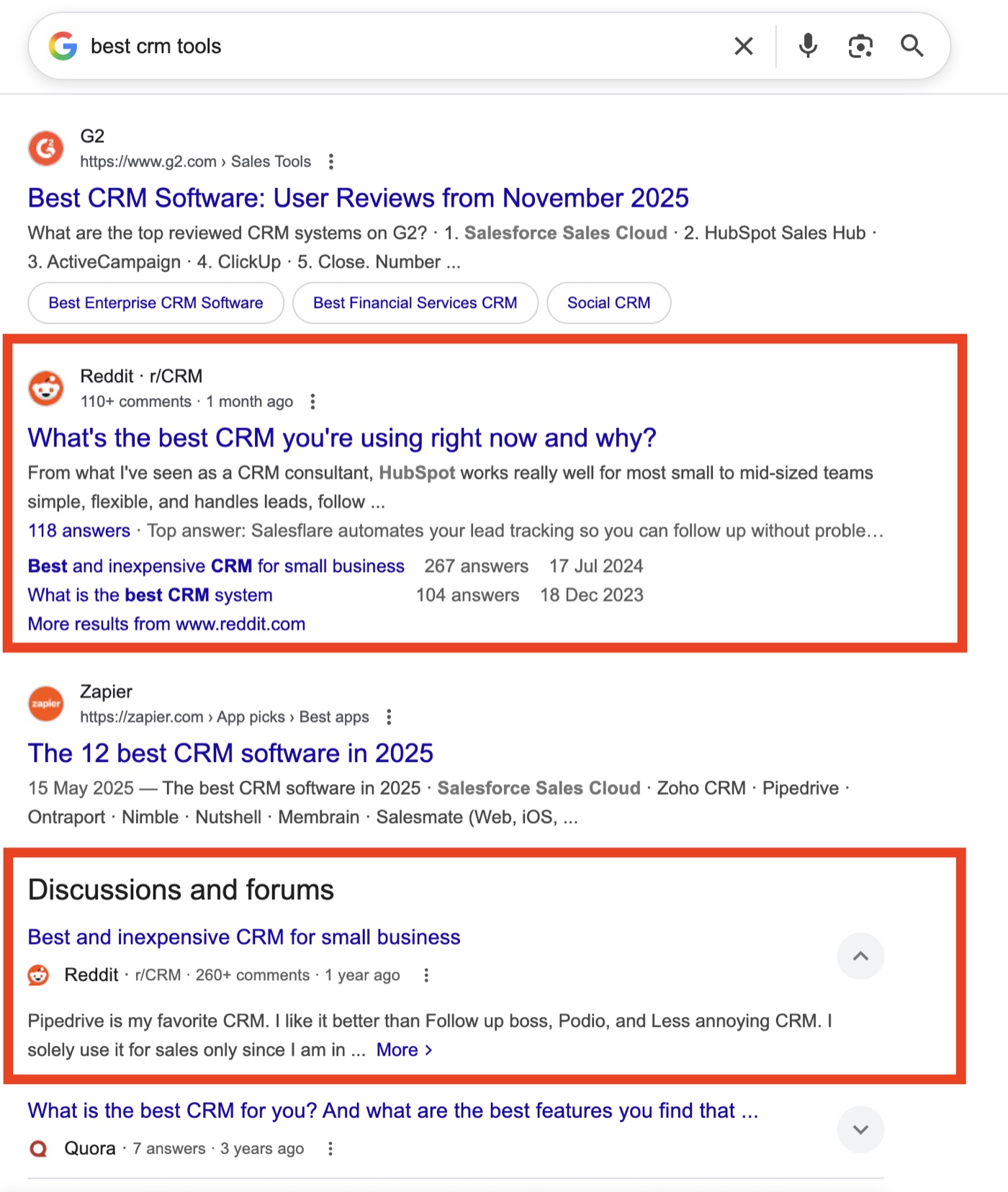
Why Reddit specifically gets pulled in. Beyond the licensing access, three structural properties matter. Reddit threads update continuously for years, so they read as fresher signal than a static article on time-sensitive or opinion-heavy questions.
The practical read: Reddit isn't a hack for gaming AI answers, it's infrastructure two of the largest AI companies paid nine figures combined to plug directly into their models. Showing up authentically inside that infrastructure, in threads that already discuss your category, is now a defensible GEO channel in a way that buying links or stuffing keywords never was.
The GEO audit: where do you actually show up
Before changing anything, find out where you stand. There's no single dashboard for this yet, so the audit is manual and repeatable rather than automated.
Build a prompt list across three tiers: branded ("what is [company]", "is [company] good for [use case]"), category ("best [category] tools", "alternatives to [competitor]"), and problem/use-case ("how do I solve [problem your product addresses]"). Fifteen to twenty prompts is enough to start. Run each through ChatGPT, Perplexity, Google AI Overviews, and Claude, and log three things for each: whether you're mentioned by name, whether you're cited as a linked source, and whether you're actively recommended versus just listed. Those are different outcomes and conflating them hides the real gap. Run important prompts twice, a few days apart, since AI answers are non-deterministic and a single run can be a coin flip.
Separately, search Reddit itself (and check Google's site:reddit.com results, since that's what's getting indexed and licensed) for the comparison and recommendation threads already active in your category. These are the threads most likely to be pulled into an AI answer the next time someone asks the question you'd want to own. If your product isn't mentioned in any of them, or is mentioned only negatively, that's the actual gap GEO work needs to close, upstream of anything you publish on your own site.
Content structure tactics that actually move citation
Once you know where the gaps are, the on-page work is straightforward and testable.
Write standalone, quotable passages. Every section should have at least one sentence that answers the section's implicit question completely, without needing the paragraph before or after it for context. That's the unit a model lifts. A sentence like "GEO focuses on being cited inside an AI-generated answer, not on ranking in a list of links" survives being pulled out of this article; a sentence that starts with "as mentioned above" doesn't.
Lead with the answer, then explain. Structure sections so the direct answer comes first and the supporting reasoning follows, the inverse of a narrative build-up. This mirrors what the Princeton KDD study found about statistics and citations: specificity up front reads as higher confidence to a retrieval system.
Use headers that match real questions. H2s and H3s phrased as the actual question a buyer types get pulled into featured snippets and AI answers more reliably than vague topic headers, because they match the shape of the query the model is trying to answer.
Build topical authority over time, not in one article. A single well-structured post rarely earns durable citation. A cluster of pages that consistently and specifically cover a topic space, cross-linked and each internally quotable, is what earns the "authoritative source" weighting the Princeton study and the domain-level citation studies both point to. Treat GEO like a content program, not a one-time optimization pass.
Earn organic mentions in threads that already exist. This is the Reddit-specific lever, and it's the one most GEO advice skips because it doesn't happen on your own domain. Genuine, non-promotional participation in the comparison and recommendation threads your buyers are already reading, answering honestly, disclosing affiliation when relevant, adding real detail, is what gets a brand mentioned inside content that Google and OpenAI are already licensed to ingest and disproportionately cite. It's slower than publishing a blog post and it can't be faked without getting caught, which is exactly why it holds up as a signal.
Measurement: there's no GEO dashboard yet, here's what works
Nobody should tell you there's a clean analytics tool for this, because there mostly isn't one yet, not one validated the way GA4 or Search Console have. What actually works is a semi-manual loop, run consistently:
- Repeat the audit prompt set monthly. The same fifteen to twenty prompts, run across the same four platforms, logged in a spreadsheet with mention/citation/recommendation columns. Trend lines matter more than any single run.
- Track branded search and direct traffic alongside it. AI answer visibility tends to show up first as a lift in branded search volume and direct visits, since people who see a brand mentioned in an AI answer often search the name directly rather than clicking a citation link. Google Search Console's branded query trend is a reasonable proxy.
- Watch referral traffic from AI platforms in analytics. ChatGPT, Perplexity, and Gemini increasingly show up as identifiable referral sources in GA4 and server logs. It's a lagging, undercounted signal (a lot of AI-influenced traffic never generates a referral at all) but a rising trend is real.
- Check the underlying Reddit threads directly. If your GEO strategy includes Reddit participation, periodically re-run the prompts that used to surface a competitor's thread and see whether your brand's mention has entered the answer. This is slow-moving evidence but it's the most direct read available.
- Use paid tools once the manual process proves the channel matters. Tools like Profound, Otterly, and Peec AI automate prompt tracking across platforms once you know which prompts and which platforms are worth watching continuously. Start manual, add tooling once you have a baseline worth automating.
This is also where our own client work has been the clearest proof. Two accounting and finance software brands we've run Reddit programs for, BlackLine and FloQast, both started appearing inside AI-generated answers for category and comparison questions after sustained, authentic Reddit participation, visible in side-by-side before-and-after screenshots rather than a single vanity metric. It's the same pattern showing up in the broader case work: a Series B fintech client saw Reddit source $4.2M in pipeline over nine months, a DTC brand hit 38x week-one ROAS off four target subreddits, and a dev-tools company's single Reddit post has held the #1 Google ranking for its category for over a year.
FAQ
Is GEO replacing SEO?
No. GEO is additive. AI answer engines still send a fraction of the traffic organic search does, and a lot of GEO's own inputs, crawlability, page speed, structured content, are SEO fundamentals under a new name. Treat GEO as a layer on top of a working SEO foundation, not a replacement for it.
How long does GEO take to show results?
Longer than most people want to hear. Citation behavior across AI platforms shifts week to week (see the ChatGPT Reddit citation swing from 60% to 10% in a matter of weeks), so a single content push rarely produces a stable, durable citation. Topical authority and genuine community presence, the things that actually move the needle, build over months, similar to how backlink-driven SEO authority compounds rather than spikes.
Do I need to be active on Reddit specifically to do GEO well?
Not exclusively, but given the documented licensing deals and the citation studies above, ignoring Reddit means ignoring one of the highest-leverage, most disproportionately-weighted sources in the current AI answer ecosystem. It's not the only lever. It's one of the few that's independently verifiable and hard to fake.
What's the single biggest GEO mistake companies make?
Writing content optimized for a page to rank instead of writing individual passages that can stand alone as an answer. A page can hold the top Google ranking and still be functionally invisible to an AI answer engine if none of its sentences are quotable without the surrounding context.
Related reading
- Does ChatGPT Cite Reddit? What the Real Data Shows
- How to Rank in AI Overviews and ChatGPT Using Reddit
- Reddit SEO agency
If you want a Reddit program built specifically to move the metrics that actually correlate with AI answer visibility, not just impressions and karma, book a call with Subreddit Marketing and we'll walk through what that looks like for your category.
Ready to run Reddit like a channel?
30-minute intro call with a partner. If we're not the fit, we'll tell you in the first five minutes.
We take on 3 new engagements per quarter. Serious teams only.