LLM SEO: 6 Tactics That Actually Move Citations
LLM SEO is optimizing content so ChatGPT, Claude, and Perplexity retrieve and cite it correctly. Six tactics grounded in real citation research, not guesses.
2026-07-18

LLM SEO is the practice of structuring and distributing content so large language models retrieve it, understand it correctly, and cite it when someone asks ChatGPT, Claude, Perplexity, or Gemini a question in your category. It overlaps with GEO (Generative Engine Optimization) but the emphasis is narrower: GEO covers the full AI-search experience, LLM SEO is specifically about what makes a model's retrieval and citation layer pick your page over a competitor's. Traditional SEO optimizes for a ranking algorithm that returns ten blue links.
We run Reddit-centered growth programs for funded B2B SaaS, fintech, and DTC brands, and LLM SEO sits directly inside that work now - clients have shown up in AI Overview citations for competitive terms, and understanding why is more useful than chasing any single platform's current behavior. Below are six tactics grounded in published research from Ahrefs, Search Engine Land, and Princeton's GEO study, not generic SEO advice with an "LLM" label pasted on top.
Why LLM SEO isn't just GEO with a different name
The distinction matters because the two disciplines reward slightly different things. GEO, as originally defined by the Princeton/Georgia Tech research team, is about maximizing visibility inside a generative answer, sometimes through techniques like adding statistics, quotations, or citing authoritative sources, which their study found boosted visibility by 30-40% in controlled tests. LLM SEO is the applied, ongoing version of that: understanding retrieval mechanics well enough to make your content a reliable pick, month over month, across query variations.
One data point makes the gap concrete. Ahrefs' analysis of 15,000 prompts found only 12% of the links cited by ChatGPT, Gemini, and Copilot also appeared in Google's own top 10 for the same prompt. Ranking well in classic Google search and getting cited by an LLM are correlated but not the same game - which is exactly why six tactics below are specific to how models retrieve and quote, not just how Google crawls and ranks.
1. Put a self-contained answer near the top, before any setup
Search Engine Land's analysis of content traits ChatGPT actually quotes found that "answer capsules" - clear, self-contained blocks of text that fully answer a likely question - were the single most consistent predictor of citation. The same research found something counterintuitive: among posts with answer capsules, more than nine in ten of those capsules contained no hyperlinks at all. A clean block of prose, unbroken by inline links, is easier for a model to lift and attribute cleanly.
Separately, analysis of citation distribution found 44.2% of LLM citations pull from the first 30% of a page's text. That's a sharper front-loading requirement than classic SEO ever had. A page that opens with three paragraphs of scene-setting before answering the actual question is optimized for a human willing to scroll, not for a model deciding in the first few hundred words whether this page is worth quoting.
What this looks like in practice: answer the core question in the first 1-2 sentences after your H1, in plain declarative language, with the primary numbers or facts stated directly rather than implied. Save the narrative, the caveats, and the methodology for after the capsule, not before it.
2. Build real topical depth instead of another thin page
LLMs don't cite a single page in isolation; they weigh it against how consistently a domain covers a topic. This is the same logic behind Google's long-standing preference for topical authority, but it matters more for LLM citation because models are synthesizing an answer from multiple sources and defaulting to whichever domain shows the most consistent, deep coverage of the subject rather than one lucky page that happens to rank.
Ahrefs' study of 75,000 brands found that brand web mentions correlate with AI citation rates at 0.664, roughly three times stronger than the correlation with backlinks (0.218). That's a signal about breadth and consistency of coverage across the web, not about any one optimized page. A single well-optimized article competing against a domain that's published a dozen genuinely useful, interlinked pieces on the same topic is going to lose the citation, even if the single article is individually well written.
What this looks like in practice: build out a cluster, not a one-off post. If you're targeting a topic, cover the adjacent questions a buyer would actually ask next, and link them together so both a crawler and a model reading the page can see the domain has range on the subject.
3. Earn mentions on high-trust third-party sources, especially Reddit
This is the tactic most SEO advice skips because it's harder than fixing your own site, and it's also the one with the clearest data behind it. Reddit is the single most-cited domain in Google AI Overviews (roughly 21% of citations) and the most-cited domain on Perplexity, where citation rates for some query categories reach 46.7%. On ChatGPT, Reddit sits at #2 behind only Wikipedia. Reddit's citation share also grew at least 73% across tracked categories between October 2025 and January 2026, more than doubling in some industries.
The broader pattern is even more lopsided in favor of earned mentions over anything you can buy. Muck Rack's May 2026 Generative Pulse study, which analyzed more than 25 million links cited by ChatGPT, Claude, and Gemini, found earned media accounts for 84% of all AI citations while paid and advertorial content accounts for 0.3%. You cannot pay your way into an AI answer. You earn your way in by being discussed on sources these models already trust, and Reddit is one of the most reliable of them.
Why Reddit specifically: models are trained to treat first-person, experience-based language differently than marketing copy. A comment that says "I switched from X to Y and here's what actually broke" reads as a direct, credible answer to a comparison question in a way a vendor's own landing page structurally can't, because the vendor page has an obvious incentive to only say good things.
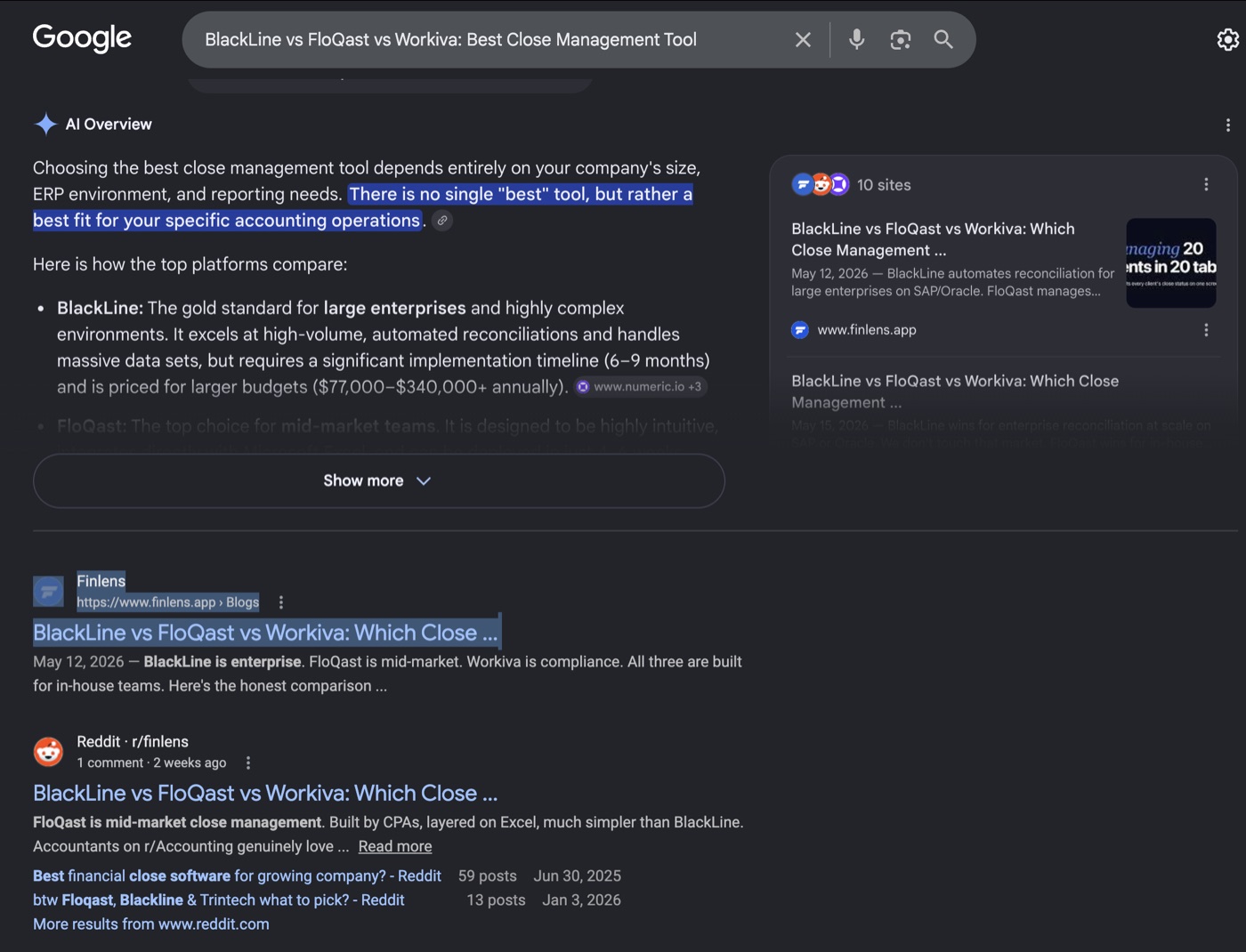
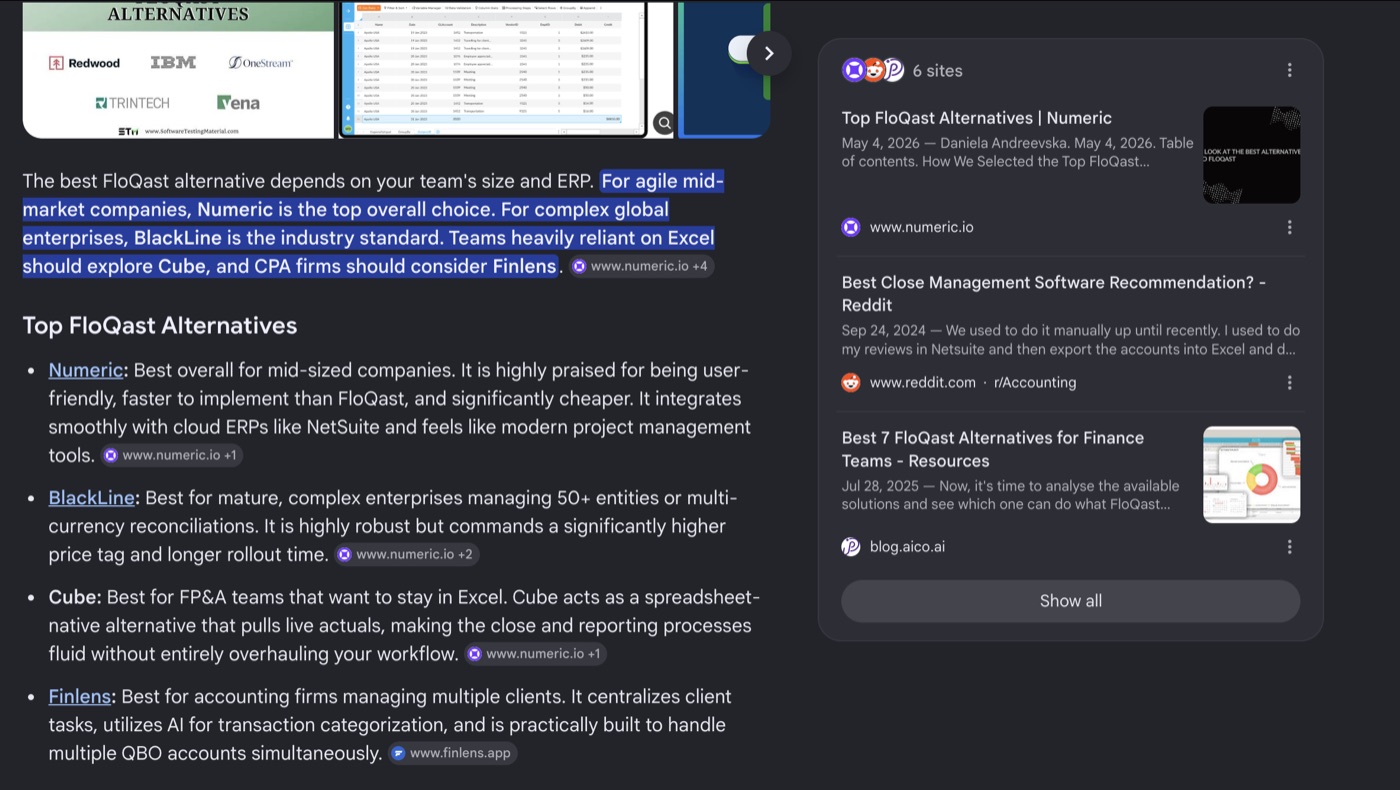
This is a real channel we've run for our own clients. For Finlens (month-end close software for accounting firms), community-sourced content now surfaces inside Google's AI Overview and ranks page one for the competitive comparison queries the whole category searches: a "best FloQast alternative" AI Overview citation, and a #1 organic result for "BlackLine vs FloQast vs Workiva" where the Finlens blog and an r/finlens Reddit post rank back to back. That's not a guarantee any brand can replicate on demand, but it's evidence the mechanism works when the underlying conversations are genuine and the brand shows up credibly inside them, not through planted comments or upvote manipulation.
What this looks like in practice: participate in the subreddits your buyers already use, answer real questions honestly, and let comparison threads happen organically instead of trying to seed them. Models can generally tell the difference between an authentic thread and an astroturfed one, and getting caught looks worse than not trying.
4. Use schema markup and clean technical structure
Structured data gives models an explicit signal about what a page represents instead of forcing them to infer it from raw HTML and prose. Google and Microsoft have both confirmed publicly that they use schema markup inside their generative AI features, and OpenAI has confirmed ChatGPT uses structured data to help determine which products it surfaces.
JSON-LD is the practical implementation: Article/BlogPosting schema for content pages, FAQPage schema around genuine Q&A sections, Organization and Person schema so a model can resolve who's actually behind the content, and Product or Review schema where relevant. None of this replaces good writing. It removes ambiguity for a system that has to parse thousands of pages quickly and doesn't have time to guess.
What this looks like in practice: audit your key pages for missing or broken schema before writing new content. A well-written page with no structured data is still readable by a model, but it's competing against pages that removed the guesswork entirely.
5. Answer the actual question instead of optimizing for a keyword
Keyword-stuffed content built for a 2015-era ranking algorithm is a liability in LLM retrieval, not a neutral non-factor. Models are evaluating whether a passage directly and completely answers the specific question a user asked, phrased however that user actually phrased it, not whether a target keyword appears at the right density. The Princeton GEO research found that adding concrete statistics and direct citations to sources each independently boosted a page's visibility inside generative answers by 30-40% - because both make a passage more directly and verifiably responsive to a question, not because they satisfy a keyword pattern.
This connects back to the answer-capsule finding in tactic one: the pages getting quoted are the ones that read like an actual answer to an actual question, written the way a knowledgeable person would explain it out loud, with real numbers attached. A page optimized to rank for "reddit marketing agency" by repeating that exact phrase eight times is optimizing for an algorithm that's being phased out in favor of one asking "does this passage genuinely resolve what the user wants to know."
What this looks like in practice: write the sentence that answers the question a real person would type into ChatGPT, then build the supporting content around that sentence. If you wouldn't say it out loud to a colleague who asked you directly, it's probably not going to read as a trustworthy answer to a model either.
6. Keep content current and show your work is still accurate
Reddit's freshness advantage in tactic three isn't unique to Reddit; it's a broader pattern. Models weigh recency and ongoing accuracy when a query has any time-sensitive component - pricing, feature comparisons, "best X in 2026" style questions, anything where a page written once in 2023 and never touched again is likely to be stale or simply wrong. A domain with a visible pattern of updating and correcting its own content is a more attractive source than one with pages that haven't moved in years.
This is also where technical crawlability intersects with LLM SEO directly: if your sitemap, last-modified dates, and canonical structure don't reflect that a page was actually updated, a model (or the search index feeding it) has no signal that the content is current, even if you did update it. Freshness has to be both real and legible to the systems reading your site.
What this looks like in practice: set a review cadence for pages targeting time-sensitive or comparison queries, update the actual content (not just a "last updated" timestamp with no real change), and make sure your technical SEO reflects genuine freshness rather than a cosmetic date bump.
FAQ
Is LLM SEO the same as GEO?
They overlap heavily but aren't identical. GEO is the broader discipline of optimizing for generative AI answer engines generally, including techniques the Princeton/Georgia Tech GEO study tested like adding statistics and quotations. LLM SEO is the more applied, ongoing practice of understanding a specific model's retrieval and citation behavior well enough to consistently earn citations over time, not just in a one-off test.
Do I need to abandon traditional SEO to do LLM SEO?
No. Ahrefs found only 12% overlap between Google's top 10 and the URLs cited by ChatGPT, Gemini, and Copilot for the same prompts, which means the two channels reward overlapping but distinct signals. Technical SEO, schema, and topical depth serve both. The differentiator for LLM citation specifically is front-loaded, self-contained answers and third-party validation, especially from community sources like Reddit.
Does adding more keywords help LLM SEO?
No, and it can actively hurt. Models are evaluating whether a passage answers the actual question asked, not keyword density. The research behind tactic five found statistics and direct citations to sources boosted AI visibility 30-40% each; keyword repetition wasn't a factor in that lift at all.
How long does it take to see LLM SEO results?
There's no fixed timeline, and any specific promise here would be a guess dressed up as data. Reddit's citation share across AI platforms moved 73% in a matter of months following changes on the platforms' side, not from any single brand's actions, which is a useful reminder that citation behavior shifts with the platforms too. Consistent execution across structure, depth, and third-party mentions compounds over time; there isn't a shortcut that produces citations on a fixed schedule.
Where this fits into an actual program
None of these six tactics work in isolation, and none of them are a substitute for the others. Schema markup won't save a page that doesn't actually answer the question. Answer capsules won't matter if the domain has no topical depth behind them. And third-party validation, Reddit specifically, is the tactic most agencies skip because it requires actually showing up in communities over months, not shipping a schema update in an afternoon.
Related reading
- Does ChatGPT Cite Reddit? What the Real Data Shows
- Generative Engine Optimization: The 2026 Playbook
- Reddit SEO agency
If you're a funded SaaS, fintech, or DTC brand trying to figure out where your category is already being discussed and cited, and want a Reddit program built around genuine participation rather than manufactured buzz, book a call with Subreddit Marketing.
Sources:
- How to get cited by ChatGPT: The content traits LLMs quote most - Search Engine Land
- Only 12% of AI Cited URLs Rank in Google's Top 10 for the Original Prompt - Ahrefs
- Why Reddit dominates AI citations across all engines - Discovered Labs
- AI Search Citations 2026: Why Reddit Dominates ChatGPT, Perplexity, and Google AI Overviews - ZipTie.dev
Ready to run Reddit like a channel?
30-minute intro call with a partner. If we're not the fit, we'll tell you in the first five minutes.
We take on 3 new engagements per quarter. Serious teams only.